The Minimum Viable Product for Living a Decade Longer

by Serelora
This article was originally published on Medium.
Read full article on MediumWhy small improvements across sleep, diet, and movement compound into years of life
By Luis Cisneros, CEO | Serelora
The modern wellness industry wants you to believe that living longer requires turning your life into a full-time optimization project. Cold plunges. Sleep trackers that cost more than rent. Meal prep as performance art. Every morning is a biochemistry experiment. Every evening is data entry. Then a new UK Biobank study drops in eClinicalMedicine and says the minimum viable product for adding a year to your life is almost offensively modest. Five extra minutes of sleep. Two additional minutes of physical activity. Half a serving of vegetables daily.
Five minutes of sleep is one more episode of a show you’ve already seen. Two minutes of movement is walking to the fridge with appropriate dramatic sighs. Half a serving of vegetables is three baby carrots having an existential crisis. This is not the stuff of transformation montages. This is Tuesday with slightly better choices. But the researchers followed 59,000 adults and found something subversive about exactly these kinds of choices. Meaningful change doesn’t operate like venture capital, where you make dramatic bets and most ventures fail. It operates like compound interest. Small, consistent, almost embarrassingly boring.
Three Modest Changes Beat One Perfect Habit
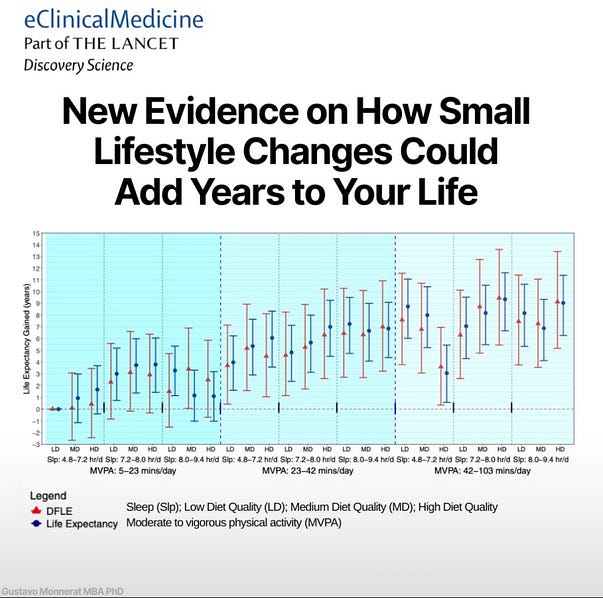
The study measured three dimensions across the entire cohort. Sleep duration, meaning actual unconscious hours rather than time spent in bed doom-scrolling. Diet quality, assessed using the Mediterranean diet adherence scale because apparently the Greeks figured something out between inventing democracy and financial crisis. Physical activity, ranging from minimal to the kind that makes you slightly out of breath but still capable of conversation. What emerged from tracking these behaviors over time was an elegant finding about how they interact. All three matter. But you don’t need to perfect any single one. The combinations work synergistically, meaning three mediocre improvements beat one heroic transformation.
The optimal behaviors got linked to 9.4 additional years of both lifespan and disease-free living. That’s nearly a decade. But the interesting part is that you don’t need optimization to see returns. Want four extra years of disease-free life? The minimum investment is 24 more minutes of sleep, which is approximately the time you spend scrolling Instagram before bed while feeling vaguely guilty. Add 4 additional minutes of movement. Include modest dietary improvements like one cup of vegetables, one serving of whole grains, two servings of fish weekly. None of these changes individually looks like much. Together they compound into years you didn’t expect to have.
This portfolio approach may be more effective precisely because it’s sustainable. Committing to an hour at the gym feels like sacrifice. Adding two minutes of movement to what you’re already doing? That’s statistical noise. It doesn’t feel like you’re doing anything, which paradoxically makes it easier to actually do. Our resistance to incremental improvement reveals something about how we construct narratives of change. We’re a species addicted to conversion stories. The dramatic before-and-after. The marathon runner. The reformed smoker. The person who gave up sugar and won’t shut up about it at dinner parties. Small, simultaneous improvements across multiple domains don’t make for compelling stories. They just make for longer lives.
The First Improvements Give the Highest Returns
Think about health behaviors as temporal investment. You’re literally trading present effort for future existence. Most people approach self-improvement like day traders, making dramatic bets, seeking immediate visible returns, burning out spectacularly. But longevity appears to function more like index fund investing. Boring. Diversified. Consistent. Over long time horizons, remarkably effective. No single day matters much. No single choice is catastrophic. What matters is the aggregate direction over years.
The study found progressively larger benefits as behaviors improved from low to medium to high quality across all three domains. But the curve isn’t linear. Getting from terrible sleep to merely bad sleep has enormous benefits. Getting from good sleep to perfect sleep? Much smaller gains, much higher costs. Have you met people who are serious about sleep optimization? They’ve calculated optimal room temperature to the degree, installed blackout curtains that cost more than most people’s monthly rent, and they’re slightly insufferable at social gatherings. This is classic marginal utility theory applied to human longevity. The first improvements provide the highest returns. Past a certain point, you’re just optimizing optimization.
Which brings us to the obvious methodological caveats nobody wants to hear but everyone needs to understand. This is observational data showing associations, not proof of causation. Maybe people who sleep well, move regularly, and eat vegetables are just fundamentally different humans. Perhaps they also floss, return shopping carts to the corral, and don’t ghost their Tinder matches. The diet data was self-reported, which means it’s subject to all the usual human biases about what we think we eat versus what we actually eat. Everyone’s diet looks remarkably virtuous in retrospect, especially if you don’t count the snacks. The study measured revealed preferences, actual behaviors, rather than testing what happens when you try to change these things. It’s observing people who already have different patterns and seeing how long they live.
Still, the sheer scale of the cohort (59,000 adults) and the magnitude of the associations (up to 9.4 additional years) makes it worth paying attention to, even with these limitations. The pattern is consistent across multiple behavioral combinations. The dose-response relationship holds across different levels of improvement. The effects appear in both lifespan and healthspan, meaning you’re not just living longer but living better during those additional years.
The Gap Is Smaller Than You Think
Here’s what troubles me about these findings. The gap between my current trajectory and a significantly longer, healthier life might be bridged by changes so small they barely register as effort. Five minutes more sleep. Two minutes more movement. Some vegetables. This is almost offensive in its simplicity. We’ve constructed elaborate systems around health and longevity. Entire industries. Social movements. Identity categories. And underneath it all might be something as prosaic as going to bed slightly earlier and eating some broccoli.
The marginal revolution will not be optimized, quantified, or posted to Instagram. It will happen in aggregate, across thousands of tiny choices that feel like nothing in the moment but compound into years. We’ve created elaborate rituals of optimization and measurement when the actual path to longer life might just be trying slightly less hard at being perfect and consistently more committed to being slightly better. The study suggests that transformation doesn’t require transformation. It requires showing up marginally less terrible at taking care of yourself, day after unremarkable day, until suddenly you’ve lived a decade longer than you expected.
And really, what could be more human than that? Adding years to our lives through the accumulated weight of vegetables we didn’t particularly want to eat and sleep we kept telling ourselves we could skip. The revolution will be incremental. It starts with a nap and a salad.
Koemel et al. “Minimum combined sleep, physical activity, and nutrition variations associated with lifeSPAN and healthSPAN improvements” eClinicalMedicine, 2026
RELATED ARTICLES
Explore more insights and perspectives from our team.