AESTHETIFLATION

by Serelora
This article was originally published on Medium.
Read full article on MediumThe Upcharge for the Vibe
A company that makes pictures for a living just announced it will map the inside of your body in a spa. We finally have a word for what keeps happening to medicine, and a different idea about what we owe each other instead.
I read the announcement three times before I let myself believe it. You step onto a platform that lowers you into a shallow pool of warm, gold-lit water, and as you go under, a ring holding something like half a million tiny sensors reads you with sound from every angle, the way a pod of dolphins might map a swimmer in the dark. Sixty seconds and it is done. A bank of computers turns the echo of your own body into a three-dimensional map of everything inside you, down to a fraction of a millimeter. No radiation. No magnets. No fluorescent waiting room with a clipboard. Then you climb out, dry off, and walk past the sauna and the cold plunge on your way to the smoothie bar, because the whole thing happened at a spa.
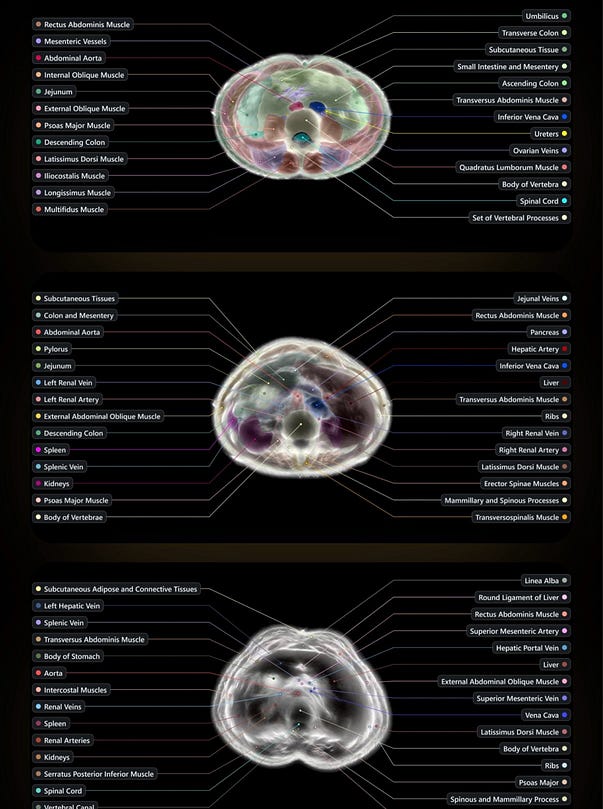
There are two honest things to say about this, and I am going to say both, because the easy move is to sneer and sneering is lazy. The first is respect. The technology is real, not a render, not a mockup. Midjourney, the company that until last week made pictures of things that were never there, has built an ultrasonic scanner that pours sound through a body in a bath of water and reconstructs it at a resolution they say rivals an MRI, at something close to a hundred times the speed, with none of the radiation and none of the coffin-sized tube. A full-body MRI takes an hour or more and costs like a used car. This takes a minute. The slices they have shown, each one fading between the raw scan and the labeled anatomy the machine has learned to name, are clean and legible and almost calm, beautiful the way good medicine should be and rarely is. Drop that machine into a county hospital and it is a gift, the kind of thing that could rewrite what preventive care even means for the millions of people who currently get none of it.
The second thing is the one that ruins my afternoon. They are not putting it in a county hospital, and they did not hide that in the footnotes. They said it flat out. Hospitals mean insurance codes and FDA clearances for every diagnostic use and sales cycles that run for years, and all of that is friction, and friction slows a launch. So the machine goes into a spa in San Francisco, ten of them to start, the scan tucked so neatly between the saunas and the plunges that the company describes the place as somewhere you would want to go even if the scanner were not there at all. In their telling the scan is a happy little side effect of an afternoon spent unwinding. You will not be a patient. You will be a guest.
There is a word for what they are doing, and I have been holding onto it, waiting for a case clean enough to earn it. Aesthetiflation. The upcharge for the vibe. It is what happens when a piece of ordinary medicine, a scan, a filling, a blood draw, a bag of saline, costs two or three or ten times what it should because the money went into the room instead of the medicine, the scent in the vents, the typeface on the app, the lighting, the feeling of the thing. The medicine does not get better. The packaging does, and you pay for the packaging like it was the cure. You can feel it the second you walk in. The place does not take insurance but it does have a signature fragrance. The person about to treat you has a title that sounds like it was invented at a startup, an Optimizer, an Architect, a Longevity Guru, anything on earth except a doctor or a nurse. And you leave cared for, lighter in the wallet, and biologically identical to the person who walked in an hour ago.
The optimization upsell
Midjourney did not invent this game. They just play it better than anyone. Before the golden pool there was Prenuvo, which takes a whole-body MRI, the same imaging your local hospital already owns, and sells it as longevity for around twenty-five hundred dollars in cash, no insurance, because it does not need insurance. The American College of Radiology does not recommend whole-body scans for healthy people with no symptoms, and the reason is simple. There is no evidence it helps them live longer, and plenty of evidence it finds things. Photograph any body in enough detail and it fills with harmless spots and cysts, and once you have seen one of yours glowing on a beautiful app you cannot unsee it. So you go chasing it back through the ugly fluorescent hospital that does take your insurance, and that chase costs you money and weeks and sleep you will not get back. They sold you peace of mind. What they handed you was the opposite.
Function Health runs a softer version of the same move, and here I have to be fair, because their story turned out more honest than the cheap reading of it. Their blood draws happen at the same Quest lab you could walk into on your own, and at three hundred and sixty-five dollars a year for more than a hundred and sixty markers, the price is not the crime. You are not paying a fortune for the blood. You are paying for the dashboard, the smooth interpretation, the quiet escalator that carries you up toward the cancer screens and the imaging where the real money lives. Then something funny happened. Function cut its price and started saying, out loud and in public, that proactive health should not be a luxury for the rich. Their own founder said it. That is the whole argument I am building toward, showing up early and out of a mouth I did not expect, and it tells you the velvet rope was never really about what the thing costs to make.
The dentists run the dirtiest version of all. Amalgam, the old silver filling, has held up the back of the human mouth for more than a century. It is cheap, it is fast, and under the grinding violence of a molar it lasts, often well past a decade and frequently a lot longer. The FDA and the ADA both hold that for the vast majority of people the trace mercury is not a clinical problem. There is one real caveat and an honest person says it out loud. In 2020 the FDA recommended that a few narrow groups skip amalgam when they reasonably can, pregnant and nursing women, small children, people with existing neurological or kidney disease or a true mercury allergy. That is a specific warning about specific bodies. It says nothing about the metal being poison in yours. The functional dentist takes that narrow warning and resells it to everyone as a toxic emergency, then drills out a sound twenty-year-old filling that is quietly doing its job and swaps in a tooth-colored composite that costs far more, looks prettier, and, because composite is fussier to lay down and tends to fail sooner under a molar, will eventually crack and need doing again. Repeat business, dressed as biology, billed as a moral upgrade. Run the same logic across the rest of the wellness menu and it holds everywhere you look. The fifty-dollar bag of saline becomes a two-hundred-and-fifty-dollar Immunity Drip the moment you hang it next to a velvet recliner and call it a ritual. Same salt water. Better lighting.
It helps to be precise about what is actually being sold here, because it was never health. Health is slow and boring and mostly cheap, a matter of sleep and vegetables and walking and not smoking, and nobody ever felt chosen buying broccoli. What these places sell is the feeling of control, the sense that you have finally done something about the low hum of dread that comes with owning a body that will one day quit on you. They sell belonging, a seat in the small tribe of people who take their optimization seriously, who have a guy, who have a panel, who have a scan. And they sell a kind of visible virtue, the quiet performance of the person who is proactive about their health, which photographs beautifully and costs everyone watching nothing to admire. None of that requires the medicine to work. It only requires the experience to feel like enough. This is the oldest trick in the anthropology of status, the conversion of a plain human need into a marker of who you are, and wellness turned out to be very good at it.
Which is what makes Midjourney the purest version yet, and the most honest, in a way I almost admire. Everyone before them at least kept up the pretense of being a clinic. Midjourney skipped it and built the spa outright. They understood, faster than most of the people who actually went to medical school, that the experience was always the product and the medicine was always the excuse. Look hard at what you are buying, at least for now, and it gets stranger. There is no diagnosis in it. The company is careful to say this is not a medical device yet, that what it sells today is a body composition map, a gorgeous inventory of your fat and muscle and bone, with the part that might actually catch something parked in a regulatory queue for some later round of approval. So you pay, at a spa, for a beautiful picture of your own tissue and the warm feeling of having been proactive, while the useful part waits. And the picture earns its keep twice, because every body lowered into that golden water is also data, raw material for the system Midjourney plans to sell to the next billion people. You are paying for the privilege of being the training set. What happens to that map of your insides, how long they keep it, whether it teaches the machine, the company will say only that more detail is coming closer to launch. You are meant to find that comforting.
Why should beautiful cost more
So here is the question under all of it, the one I actually care about and the reason any of this is worth writing down. Why should beautiful cost more. I want to be careful, because I am not the person who thinks design is free or that branding is a swindle. I know what it takes to make something beautiful, probably better than the people who assume it costs nothing. It takes energy and time and somebody willing to sit inside a hard problem long enough that the answer feels effortless to whoever meets it later. That labor is real, and it should be paid for, and I will fight anyone who says otherwise. What I will not defend is a five-hundred-percent markup on a thing that returns a marginal gain at best and nothing at worst, where the price has slipped loose from the work entirely and tied itself to something else.
That something else is exclusion, and it is the part almost nobody will say to your face. The wealthy guest paying cash for the golden pool is buying more than the scan and the sauna. They are buying the fact that you cannot be in the room. Open the beautiful thing to everyone and it stops working as a status object, and the premium drops straight through the floor. The economists have a tidy phrase for this, market segmentation, which dresses a deliberate act of exclusion up as something as natural as weather. Said plainly, the high price is a wall, built on purpose, to keep the volume low and the feeling of specialness high. The velvet rope is the product. The thing it keeps out is the thing you are paying for.
There is older machinery under this, older than any of these companies. We have all been trained to read price as a signal of worth, to assume the expensive thing is the serious thing and the cheap thing is the compromise. Price was never a clean measure of what something cost to make. It has always been a social statement, a way of announcing what a thing is for and who it is for. So when a clinic makes itself beautiful and then prices that beauty out of reach, it is doing more than covering its overhead. It is making a claim about the kind of person who belongs inside, and trusting that you will read the number the way you were taught to, as proof that something real must be happening behind the door. The quiet genius of the model is that it turns your own conditioning into the lock.
This is the part that keeps me up, because I came up in this world and watched it from the inside. Take one patient and walk them through three different doors. Through the first the payer is Medicare, the rates are fixed and thin, and the clinic runs like an assembly line, thirty or forty people a day, no budget for atmosphere and no minutes to spare. Through the second the payer is a commercial PPO, the reimbursement is better, the room a little nicer, the visit a little longer, though it all still bends to whatever an actuary somewhere decided was necessary. Through the third the patient pays cash, the provider names the number, sees eight people instead of forty, and to justify charging hundreds of dollars out of pocket has to hand over the scented towels and the unhurried hour and the language of optimization. Same patient. Same body. The science that decides whether they get better does not change across those three doors. What changes is the lighting, the wait, the number of minutes a human being looks at them instead of at a screen, and the price.
And that is the quiet horror of the spa scanner, the thing the warm water is built to make you forget. The machine does not care which door it sits behind. The same sixty-second scan that could live in a community clinic in a neighborhood that has never had an imaging center is going instead into a wellness club in one of the most expensive zip codes in America. Nothing in the physics required that. It was a choice, made by people who looked at a tool that could close the distance between the haves and the have-nots and decided the cleaner business was to widen it. The velvet rope is always a decision wearing the costume of a fact.
And the choice gets harder to forgive when you follow the money back to where it started. Almost none of this was invented by the people charging you for it. The ability to map a living body from the outside exists because the public paid for it, slowly, across decades, in university labs funded by the NIH and agencies like it, the same way nearly all of the foundational science under modern medicine got paid for, by all of us, together, long before any of these companies had a name. The government even hands seed money straight to startups, through programs like the SBIR grants built for exactly this, to help small companies start building technology like this. Even the one company in this story that took no investors and no grants and paid for its own scanner did not invent the physics that makes the scanner work. So lay it out end to end. You paid once, as a citizen, to bring the thing into the world. Then it gets wrapped in gold light and a signature scent, and you are asked to pay again, in cash, at a number set high enough to keep you on the wrong side of the door. You funded the research and then got priced out of the result. This is the market working exactly as designed, on a foundation you bought and were never once invited to stand on.
Aesthetic justice
So let me put the actual idea on the table, the one I have been circling this whole time, the word I would like to leave behind in trade for the one I have spent all these pages complaining about. Call it aesthetic justice. The simple, stubborn conviction that beauty belongs to everyone, that dignity is a floor and not a reward, and that the question we ask of anything we build, right alongside whether it works, is who it is beautiful for.
I will not take the trade they keep offering, the one where you get either the beautiful experience or the affordable one and never both at once. It is a false choice, and it always was. You can make a thing genuinely beautiful and still price it in the accessible middle, the place most people can actually reach, and still be paid honestly for the craft of making it beautiful. The margin should track the labor and the care that went in. It should never track how many people you managed to keep standing outside.
The other version is not complicated, only unfashionable. The same gorgeous scanner, the same sixty seconds of sound and water, sitting in a clinic in a neighborhood that has never had an imaging center, the light just as warm, the room just as calm, except the person walking in carries Medicaid and walks out having paid nothing, or close to it. A waiting room designed by somebody who actually gave a damn, inside a public hospital, for people who have spent their whole lives being processed like a number under fluorescent lights in rooms that smell like fear. None of that is a fantasy of technology. The technology already exists, or is about to step dripping out of a pool in San Francisco. It is a fantasy of priorities, which is a far cheaper thing to build and a far harder thing to want.
I build clinical AI for a living, so this is not a theory I get to hold from a safe distance. The thing I am chasing, the thing the people I work with are chasing, is software that is beautiful and clear and honest about its own reasoning, that shows you exactly where every conclusion came from instead of asking you to trust a pretty surface, and that costs little enough that a small urgent care in a working neighborhood can run it as easily as a concierge clinic on the coast. There is nothing charitable about it. It is the entire point of the work. Build the beautiful version only for the people who were already going to be fine and you have not built medicine. You have built another spa.
Once you have the word, you start seeing the choice everywhere, far past medicine. The beautiful school sits in the rich district and the grim one sits across the tracks. The public space that actually feels like care gets handed to the neighborhoods that already had everything. The software the poor are forced to use, the benefits portal, the clinic intake, the government form, always looks like it was designed in open contempt for the people filling it out, while the apps built for the wealthy slide like glass under your thumb. The same logic runs through all of it. Beauty keeps getting treated as a reward for having already made it, when it should be the floor we lay for everyone, and first of all for the people the world has spent the least energy being gentle with. Aesthetic justice is just the name for the refusal to keep treating beauty as something the poor have to earn.
But it always comes back to the body, because that is where the stakes stop being a metaphor. A person on Medicaid and a person with a platinum PPO are the same animal. Same biology, same fear sitting in the same chest when the news comes back wrong. The science we point at them should be the same science, and so should the care taken with the room, the clarity of the explanation, the calm of the design, the plain dignity of being treated like someone worth the trouble. There is no honest reason for any of that to be sorted by the card in a person’s wallet, and the fact that we have all quietly agreed to pretend there is should sit a lot heavier on us than it does.
Midjourney’s scanner is going to be remarkable, and I mean that without a drop of sarcasm. The engineering is real, the images are lovely, and a sixty-second scan with no radiation is something the field has wanted for a very long time. The only question that matters, the one no amount of golden light and warm water can answer for you, is who gets to step into the pool. Aesthetiflation is what you get when beauty is used as a wall. Aesthetic justice is what happens when you decide, on purpose and against the easy money, to use it as a door. Build the beautiful thing. Then let everybody in.
References
1. Midjourney Medical, official announcement (ultrasonic full-body scanner, MRI-comparable resolution at roughly 100x speed, the Midjourney Spa, body composition maps first, FDA path). https://www.midjourney.com/medical/blogpost
2. Midjourney Medical, Scan Gallery (reconstructed slices, AI segmentation, torso and leg volume sweeps). https://www.midjourney.com/medical/scan_gallery
3. Engadget, “Midjourney is developing a full-body ultrasonic scanner” (Butterfly Network partnership, 60 seconds versus 60 to 90 minutes for a full-body MRI). https://www.engadget.com/2196998/midjourney-full-body-ultrasonic-scanner/
4. Tony Reviews Things, Midjourney Medical scanner hardware reveal (spa as data-acquisition strategy, San Francisco location by end of 2027, 50,000 scanners and one billion scans per month by 2031, “real engineering, not a concept render”). https://www.tonyreviewsthings.com/midjourney-medical-scanner-hardware-reveal/
5. AI Chat Daily, “Midjourney pivots to hardware” (Butterfly Ultrasound-on-Chip modules, around ten scanners at the SF spa, data retention and training-use rights not yet specified). https://www.aichatdaily.com/ai-news/midjourney-pivots-hardware-full-body-ultrasound-scanner
6. Radiology Business, Prenuvo subscription launch ($2,499 scan, no insurance, ACR does not support whole-body MRI of asymptomatic individuals). https://radiologybusiness.com/topics/healthcare-management/healthcare-economics/whole-body-mri-provider-prenuvo-launches-annual-imaging-subscription-service
7. Function Health, “Function membership is now $365/year” (160-plus lab tests via Quest, framed around accessibility); see also Athletech News on the price drop and the “proactive health should not be a luxury” framing. https://www.functionhealth.com/article/function365
8. FDA, “Recommendations for Certain High-Risk Groups Regarding Mercury-Containing Dental Amalgam” (2020 safety communication). https://www.fda.gov/news-events/press-announcements/fda-issues-recommendations-certain-high-risk-groups-regarding-mercury-containing-dental-amalgam
RELATED ARTICLES
Explore more insights and perspectives from our team.