The Rot Revolution

by Serelora
This article was originally published on Medium.
Read full article on Medium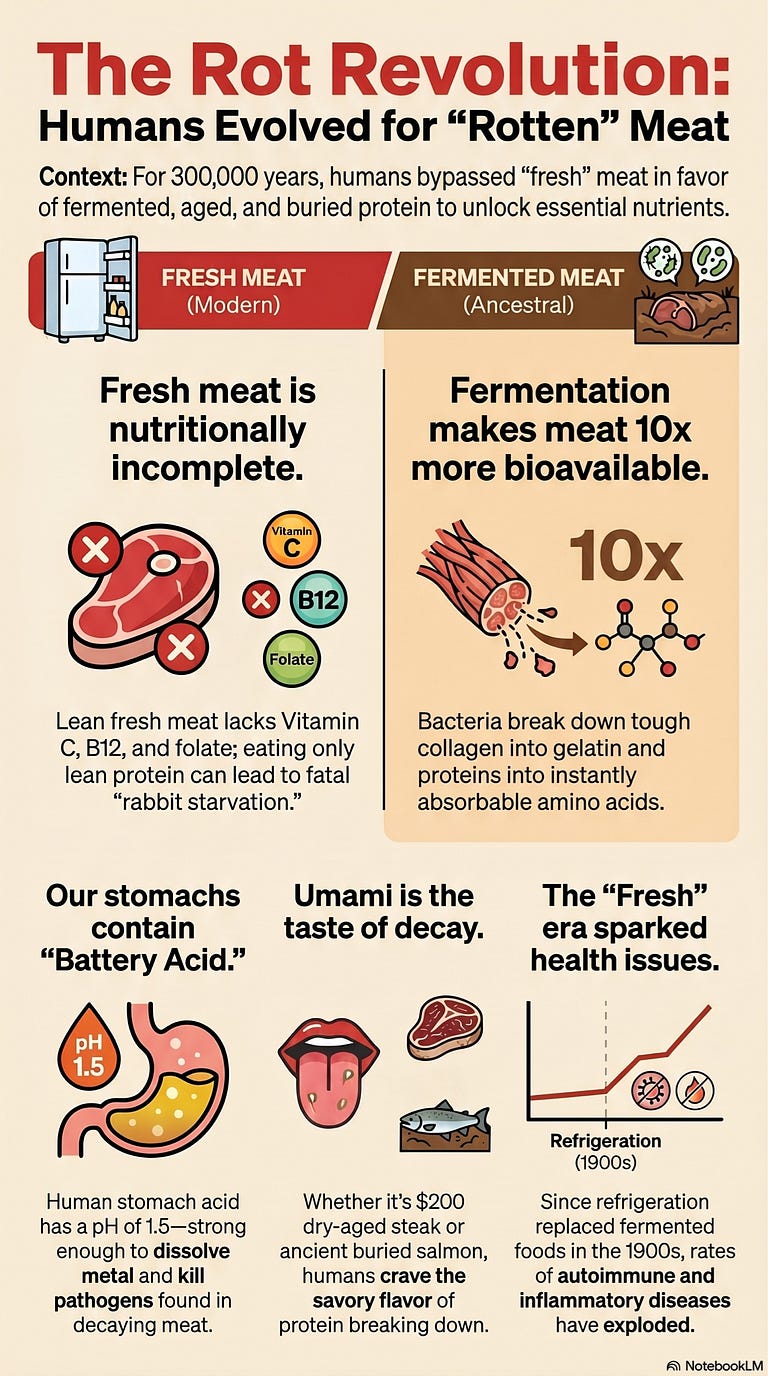
Between 1881 and 1884, twenty-five men went into the Arctic on an American scientific expedition, and only six came out. The official story was cold and bad luck and worse planning, and all of that is true. But decades later, the explorer Vilhjalmur Stefansson went back through the records of the Greely expedition and found something stranger buried in the timeline of who died and when. The men had been eating. Toward the end, starving and desperate, some of them had been eating the bodies of the ones who’d already died. And Stefansson noticed that the ones who ate the most were often the ones who died next.
He had a name for what he thought was happening, an old grim name he’d picked up living among Arctic peoples. Rabbit starvation. The bodies of starved men carry almost no fat, nothing but lean muscle, and lean muscle, eaten by itself with no fat and nothing else, is not food. It is closer to a slow poison. The human liver can only convert so much protein into urea before the system floods, and past that point the protein itself turns on you, ammonia rising in the blood, the kidneys failing, a hunger that eating only deepens. You can fill your stomach and waste away at the same time. The men on that expedition were, at the very end, killing themselves with the only meal they had.
I find this hard to shake, because it points at something we have spent a century refusing to believe. Fresh lean meat, the thing we now call good, the thing we pay extra for, will not keep a human being alive. Stefansson saw it again and again. Lewis and Clark’s men got sick living on lean elk. The forest hunters he stayed with in 1906 would bring down a rabbit and feed the lean meat to the dogs, keeping only the fat, and when he asked why they were throwing away good meat they looked at him like he was a child. They knew something he didn’t yet. They knew that meat is not simply meat, and that the fresh kill of the fantasy, the hunter and the fire and the noble roast, was never how anyone actually survived on this stuff for long.
So if fresh lean meat is a trap, and our ancestors lived on animals for the better part of three hundred thousand years, the obvious question is what they were doing that we aren’t. And to get at the answer you have to be willing to go somewhere genuinely revolting.
So let’s go to Greenland.
There’s a dish there called kiviak, and people still make it, and the recipe reads like a confession. You start with a seal, and you hollow it out, leaving the fat behind. Then you take the little Arctic birds called auks, the small ones, somewhere between three and five hundred of them, whole, and I do mean whole, beaks and feet and feathers and all, and you pack them into the seal’s body until it can’t hold another bird. You sew it shut and you smear the seams with seal fat so the flies can’t get in, and you bury the whole obscene parcel under a heap of stones with a heavy rock on top to press the air out. Then you wait. Not a week. Months, through the long dark, sometimes the better part of a year. The birds ferment inside the seal, and when winter has locked the world down and there is nothing left to hunt, the family comes back, lifts the stones, reaches in, pulls out a bird, and eats it. The fermented insides, by every account, taste like a very old and very angry cheese. Gorgonzola that’s seen things.
Your whole body wants to reject this, and so did mine. We’ve been trained from the cradle to read fresh as life and rotten as death, and every nerve says the people eating a months-old bird out of a dead seal must be either starving or out of their minds. They are neither. The Inuit who make kiviak are not desperate and they are not primitive. They worked out a piece of chemistry that the British and American navies died for lack of, and they worked it out so long ago that nobody remembers learning it. The rot is not the failure of the dish. The rot is the entire point of the dish. It’s the thing that carries them through a winter that lean meat alone would kill them in.
Because here is what’s actually happening inside that seal, and it’s the same thing happening in fermented foods on nearly every continent humans ever walked across. Decomposition, the thing we file under danger and disgust, is mostly just digestion that happens outside the body instead of inside it. The same bacteria, the same enzymes, the same breaking-down, except the meat does the hard work in the ground over months so your gut doesn’t have to do it in agony over hours. The collagen that makes fresh muscle so punishing to chew dissolves quietly into gelatin. The long protein chains your stomach would have to laboriously take apart fall apart on their own, into free amino acids the body just absorbs, no fight required. And the bacteria doing the work manufacture the very things the fresh kill was missing, the B vitamins, the folate, building them out of nothing while you wait. An invisible workforce that asks for no wage and hands back a richer food than it was given.
This isn’t a quaint theory, by the way. It’s where the science has been quietly moving. For a long time the high meat signatures in Neanderthal bones made everyone picture them as pure predators, wolves with flint. But humans and our close relatives can’t actually tolerate that much lean protein, the rabbit starvation problem again, and a growing body of research now argues that what those bone chemistry readings actually point to is fermented, aged, deliberately rotted meat and fish. Not desperation food. The plan. The way you get the nutrition out of an animal without poisoning yourself on its lean muscle, in a world with no refrigerators and not always a fire.
There’s a taste to all of this, too, and the taste is the giveaway. When protein breaks down it releases glutamate, and glutamate is the molecule underneath umami, that deep round savory weight you chase in aged parmesan and fish sauce and a steak that’s hung a while. Umami is, stripped of all the romance, the flavor of meat coming apart. We are built to find it delicious. We’re built that way because the animals that found rotting protein delicious were the ones that ate it and lived, and the ones who found it revolting starved on principle and left no descendants. Every time you reach for something savory you’re obeying an instinct three hundred thousand years deep, pointing straight at the buried, fermented thing your ancestors knew was the best food they had.
I know the objection, because I had it too. Doesn’t this just kill you? Isn’t rotten meat how you get botulism and a bad death in the dark? Sometimes, if you do it wrong. But these people were not doing it wrong. They had the whole chemistry worked out without a single word of the vocabulary. The trick was burial, and the trick inside the trick is that burying meat deep gets you cold and gets you airless, and the bacteria that actually hurt you, the salmonella, the E. coli, need warmth and oxygen to bloom. Take those away and they can’t get going. What thrives instead, down in that cold dark, are the anaerobic bacteria, the same quiet family that turns milk into yogurt and cabbage into kimchi. They flood the meat with lactic acid, the acid pickles it from the inside, the pH drops past the point where any pathogen can survive, and the whole thing stays stable and edible for months. The Romans ran their own version above ground, packing fish and fish guts with salt and leaving them in the Mediterranean sun for months to make garum, a sauce they poured over nearly everything, the ketchup of the ancient world, beloved at every level of society from the docks to the emperor’s table. It was controlled rot, and they could not get enough of it. Cultures that never met, on continents that never traded a single object, all arrived at the same disgusting answer. Bury it, salt it, wait, eat well. When that many strangers independently invent the same revolting thing, it stops being revolting and starts being wisdom.
And then there’s the evidence you’re carrying around right now, where you can’t see it. Human stomach acid runs at a pH of around 1.5. That is not a normal number. It’s close to battery acid, and it is far more savage than what you find in the stomachs of the apes we’re related to, which sit three or more points higher on the scale and have no need for anything stronger. So why do we have a vat of acid in our bellies strong enough to make a vulture comfortable? Because, the leading explanation goes, we were never the elegant hunters of the fantasy. We were scavengers. We were the animal that came on the carcass days late and ate it anyway, and the only ones who lived to become us were the ones whose stomachs could chemically incinerate whatever was already growing on the meat. Your gut acid is in the same brutal range as the obligate scavengers, the vultures and their kind, and that is not a flattering fact, but it is a useful one. The body remembers what the culture forgot.
The difference between the rot that heals and the rot that kills
Now I have to be fair to the other side of this, because there is a version of this argument that romanticizes rot into nonsense, and I don’t want to write that one. Not all rot is the controlled kind. The whole reason kiviak works is that it is rot on a leash, cold, airless, soured by lactic acid into something stable. Take the leash off and you get the other thing. You get a piece of meat sitting in the warm open air, oxygen everywhere, the dangerous aerobic bacteria multiplying with nothing to stop them, marching toward a state that will put you in the ground. The ancestors who buried their seal understood the difference in their bones. The trick was never rot for its own sake. The trick was always control.
And here is the part the romantic version conveniently skips. For most of the nineteenth century, the cities of the industrializing world were not practicing controlled rot. They were drowning in the uncontrolled kind. Meat spoils in hours in summer heat, and the growing cities were full of open-air slaughterhouses, the shambles, where animals were killed and sold in conditions that reformers spent decades begging to have moved somewhere, anywhere, else. There was no cold chain. A carcass killed on a hot morning and sold by afternoon had already begun to turn, and nobody selling it had any way to know how far. People got sick constantly. They had a word for it that they threw at every case of the resulting misery, ptomaine poisoning, named for the foul compounds of decay, and while the science behind the word turned out to be half wrong, the suffering behind it was entirely real. This was rot with nobody steering. Not the patient anaerobic fermentation of a buried cache, but raw decomposition sold to strangers in a market, a roulette wheel of bacteria played out across whole populations at once.
Refrigeration walked into that catastrophe and ended a huge part of it, and we should be honest enough to call that one of the genuine triumphs of the modern world. Cold doesn’t sterilize, but it slows the dangerous bacteria to a crawl, and slowing them was exactly what the open-air city could never do. Railways and cold storage turned meat from a local gamble into something you could move a thousand miles and trust. The lethal summer markets gave way to clean, chilled supply. Whatever I’m about to say about what we lost, I’m not nostalgic for the shambles, and neither should you be. A child in 1850 was far likelier to be poisoned by the meat at the corner than helped by it. Refrigeration saved that child. That is not a small thing and I won’t pretend it is.
So the picture has two true halves that we usually mash into one. There is the rot that heals, controlled, ancient, deliberate, the fermentation that pre-digests an animal and makes it richer and safer than it started. And there is the rot that kills, uncontrolled, accidental, the meat going off in the heat with nobody minding it. They are not the same process and they never were. The tragedy is that when refrigeration arrived to save us from the second one, it took the first one out with it, because we had stopped being able to tell them apart.
How we threw out the good with the bad
For three hundred thousand years controlled fermentation was simply how humans ate, and then in the span of about two generations we tore the whole practice out by the roots. Germ theory arrived alongside the refrigerator, and it was one of the genuinely great achievements of the human mind, because understanding that invisible microbes cause disease let us beat the uncontrolled rot that had been killing the cities. But the same idea that let us kill the bad bacteria taught us to fear all of them, and we made a quiet error so total we still can’t quite see it. We stopped telling the difference between the rot that heals and the rot that harms. We just declared war on all of it. Fresh stopped meaning fresh and started meaning safe, and aging and burial and fermentation, the slow microbial pre-digestion our species had leaned on for its entire existence, got swept into the same bin as the poisoned meat at the shambles and thrown out together.
The meat on your plate tonight was killed, chilled, shrink-wrapped, and moved to you fast, often within a few days. This is, in the terms that mattered to those nineteenth-century cities, gloriously safe, and that is a real gift. But from your body’s older point of view it’s close to the worst version of meat a human has ever eaten. It’s at its toughest, before any enzyme has had time to soften it. It’s at its emptiest, carrying none of the vitamins the microbes would have built. And it brings none of the living bacteria your gut spent eons learning to expect. We made meat cleaner than it has ever been, which saved us from one disaster, and in the same motion we made it poorer than it has ever been, and we eat more of it than any people in history while congratulating ourselves on having finally gotten food right.
Now I want to be careful here, more careful than the people who usually tell this story, because this is exactly where it tips into nonsense if you let it. There is something real to point at. Since the middle of the last century, in the wealthy parts of the world, the rates of inflammatory bowel disease and a whole family of autoimmune and allergic conditions have climbed in a way that stopped looking like a trend a long time ago and started looking like a wall. Crohn’s, type 1 diabetes, multiple sclerosis, asthma, hay fever, food allergies, all of them up enormously, and up fastest in precisely the cleanest, most industrialized places. The leading scientific explanation for this is sometimes called the hygiene hypothesis, and in its more careful modern form it says roughly this: our immune systems evolved in constant negotiation with a teeming world of microbes, and when we scrubbed that world away in a single lifetime, faster than evolution can answer, the immune system lost the sparring partners that taught it restraint, and began, in too many of us, to swing at the wrong things.
I want to be honest about what that is and isn’t. It is a hypothesis, a strong and well-supported one, riding on real epidemiology, the most striking piece of which is that people who move from a low-disease country to a high-disease one tend to pick up the high rates within a single generation, which points hard at environment over genes. But it is not proven, and it is not specifically a story about fermented meat. It’s a story about a whole vanished world of microbial exposure, of which our buried, fermented, lactic-soured food was only one part. Anyone who tells you that giving up funky meat gave you your allergies is selling you something, and the world has enough of those. What I’ll say is narrower and I think defensible. We ended a three-hundred-thousand-year conversation between our guts and the living things in our food, we ended it almost overnight, and it would be a little miraculous if none of the bill came due in our bodies. That’s not a diagnosis. It’s a reason to be humble about what “clean” actually cost, even while we’re grateful for what it bought.
The joke we’re still paying for
But the part that genuinely makes me laugh, the part that’s a little humiliating if you sit with it, is that we never stopped loving rotten meat at all. We just got too proud to say the word.
Walk into any serious steakhouse and find the most expensive thing on the menu. It’s a ribeye, and it’s been dry-aged forty-five days, maybe ninety, and it costs a fortune. Dry-aging is, in language nobody at the table wants to use, controlled rot. The good kind, the leashed kind, the exact same trick the ancestors ran in the ground. You hang the meat in a cold room and you let mold grow on it, a real furred bloom of it, specific fungi that send collagen-dissolving enzymes down into the muscle while the meat’s own enzymes break it apart from within, doing in a climate-controlled locker exactly what months under a pile of Greenland stones does to a bird. After about a month the glutamate climbs sharply and the savory depth blooms with it. The chef shaves off the moldy crust, and what’s left underneath is tender and rich and flooded with umami, and the person paying a fortune for it has no idea they’re eating a refined and expensive version of the thing a Neanderthal once pulled out of the cold ground and ate with their hands. Same chemistry. Same bacteria and fungi. Same ancient instinct firing in the same ancient way. The hole in the ground became a stainless steel cabinet, the price went from nothing to obscene, and we told ourselves the whole time that it was the opposite of rotting, when it was rotting all along. Controlled rotting. The kind that was always good for us.
There’s a fermented Greenland shark dish called hákarl that the late Anthony Bourdain, a man who ate fearlessly across this entire planet, once called the single worst and most disgusting thing he’d ever put in his mouth. And he was probably right about the taste. But the joke underneath it is that he’d eaten the polite version a hundred times without flinching, every time he praised a well-aged steak. We didn’t conquer our taste for decay. We just gave it a French-sounding name and a markup and learned not to look at it directly.
That, really, is the whole shape of the thing. We took something ancient and effective and a little revolting, decided it was beneath us, banished it in the same purge that rid us of the genuinely dangerous rot, and then quietly reinvented it for the rich so we’d never have to admit what we were eating.
I don’t want this to curdle into the easy sermon, the everything-modern-is-poison routine, the call to go bury a seal in the backyard. Please do not bury a seal in the backyard. The people who did this safely carried centuries of inherited knowledge about exactly how, and the price of getting it wrong is the uncontrolled kind, botulism, the thing refrigeration rescued us from in the first place. Germ theory was right. The cold chain was right. Clean water and sterile surgery and washed hands are among the best things our species has ever done for itself, and I’d give back none of them.
The point is quieter than that, and I think more useful. Sometimes progress doesn’t simply add or simply subtract. Sometimes it does both at once and only tells you about the half it’s proud of. Refrigeration genuinely saved us from the rot that kills. It just also, in the same stroke, took away the rot that heals, because in our relief we couldn’t be bothered to keep the distinction the ancestors had died to learn. The fermented foods our bodies were tuned for didn’t vanish because anyone proved them harmful. They vanished because they got mistaken for their dangerous cousin, and the mistake was convenient, and the story moved faster than the science underneath it.
And the good news, the actual light in this, is that none of it is truly lost. Only misplaced. The microbes are still here. The knowledge still lives, unbroken, in the cultures that never once apologized for it, in the kiviak and the garum and the fermented shark and the gloriously rank corner at the back of any good cheese shop. We already know how to do this safely, which is the whole miracle of it, we have the cold and the salt and the science the ancestors never had, which means for the first time in history we could run the good rot with none of the risk of the bad. Your gut still holds the acid. Your tongue still reaches, helplessly, for the umami. The instinct never left you, not for a second. All that’s required is the humility to admit that we threw out something worth keeping, that the line between the rot that heals and the rot that kills was real and knowable all along, and that the family eating fermented seabird in the Arctic dark understood something about being human that we mistook for filth and swept away with the rest.
The rot was never the enemy. We just forgot how to tell which rot was on our side.
RELATED ARTICLES
Explore more insights and perspectives from our team.